Showing posts with label fashion. Show all posts

Wednesday, December 14, 2011

Thank you BRAHMIN!

Brahmin Handbags so kindly sent me a generous gift- two gorgeous red croc Anytime mini bags!  What a lovely treat!

BRAND NEW TO THE BRAHMIN COLLECTION!


Simple and chic the anytime mini can be worn with shoulder strap for a day out or strap can be worn wristlet style for an eveing look.  Small enough to tuck into your everyday tote or used for travel.


Get yours! http://www.brahmin.com/product/G90151NE/mineral-croco-anytime-mini-bag-mineral

Monday, August 8, 2011

Vogue Influencers Network


Vogue has launched the ‘Influencer Network,’ a platform for advertisers who want their messages spread across social media. The panel of 1,000 influential women with an interest in fashion and an online following are asked to give feedback to clients about new products, fashion collections and ad content. They are also encouraged to discuss the products with followers on their social networking sites to raise awareness for the clients and for Vogue as well.
As a member of the Vogue Influencer Network, I receive a variety of products to check out, try, use and post a comment or evaluation.

This week I received the Clarisonic Skincare system. It's not my favorite, I have to say. The brush doesn't rotate really, it vibrates and I can get just as good a result with a good exfoliator and mitt.


But, when I received Brahmin's Anytime Tote, I was floored. It is a fantastically gorgeous leather bag from Brahmin, the maker of fine leather handbags and small leather goods.


A large box was waiting on my doorstep with the gorgeously packaged handbag. The bag itself is beautifully made with solid hardware and construction. It is a preview of the collection that will be available at retail at the end of April.

The Red card attached said:

Dear Leslie,

You’ve been selected by Vogue to discover Brahmin, a luxury handbag company known for its timeless, sophisticated styles.

It also goes on to tell me that the Anytime Tote will not be available in stores until May. It will however, be available on April 15 on Brahmin.com and in the Brahmin Boutiques.

What a nice surprise!


Saturday, May 28, 2011

Influencers

What makes someone an influencer in modern society?

Who are our influencers?

In fashion, our past influencers are clear: Chanel, Vionnet, Dior, Gres, YSL, McQueen-- all are responsible for a distinct shift in perspective on design. In furniture design, Chippendale in the 1700's, Eames in the 20th century and Piet Hein Eek in the 21st century come to mind. In architecture, the innovators of their day included Frank Gehry and Frank Lloyd Wright.

I think people like Madonna, Gwen Stephanie and Lady Gaga are influencers in music, but have a temporary influence as true trend setters. It is in their saturation that makes them less of an influence, as they seem to become mainstream the moment they are copied. In today's society, people still think Gaga is an influencer. I would say that is true a year ago, but today, she is predictible and is so immitated and followed. This makes me believe she has lost her influence to be a true innovator, but simply a leader with a following. She is not unlike any other leader in the world who has a herd of sheep following blindly as they are lost and looking for someone or something on which to hang an identy.... or adopt an identity.

In the media, Mark Zuckerburg would have been an influencer in the world of social media and the way in which social media would be used today. Anna Wintour, editor of American Vogue was an influencer in the fashion media, but her power is continually being challenged by new media outlets, such as online blogs and magazine. Tavy Gevinson, the fourteen-year-old blogger truly challenged the old guard of the fashion writers with her influential blog. Hugh Hefner was an influencer in the 50's with the introduction of the first Playboy magazine.

Watching a documentary on Hugh Hefner in the 1950's made me realize something I had never thought about him- he was ahead of his time, he was not "popular," in fact, when he started, he borrowed any amount of money he could and his first issue sold only 50,000 copies. WIthin a year, he tripled that. He was ahead of his time and went against the grain of society; he did not have a following for many, many years and he promoted something that went to against what was the norm in a 1950's society and forever changed the American ideal of women and created an unattainable standard by which many American women measure themselves. Unfortunately, the start of Playboy magazine made for a perpetually-sexualized undercurrent in society that has become validated through the media and by his own controversial lifestyle. Playboy forever changed the ideal of American beauty.

His magazines were not initially all about sex, but they also included politics and controversial sibjects in the magazine. Utilizing the controversial platform of the magazine, he included in those pages his own ideas about controversial issues, like black rights in America, politics involving President Carter, racial bias in stand-up comedy artists in the 60's, etc. In his day, he was an influencer, but today, his lifestyle seems almost obscene or mundane, depending on perspective, but it is no longer innovative, nor are his ideas.

I am not perpetuating Playboy or any kind of pornography. What I am hoping for is that thought-proving change comes from talking about those who really change a mind set or a society's point of view or at least their discussions.

Are influencers those who have a large following and are popular? Is popular even a component of an influencer? Or does the influencer begin to lose his/her innovative quality because he or she is followed by so many? Should an influencer have an important point of view or vision that is innovative and intuitive to change and can influence that change?

It seems to me that the moment the influencer becomes mainstream the power he or she has is really only to get a bunch of people to copy his or her style and adopt it as their own identity, under the guise that they are truly innovative in their own personal style, when in essence they are only copycats. It seems to me that the moment he or she becomes popular is the exact moment he or she ceases to be innovative. Why is being innovative a necessary trait for an influencer to possess?

So, who are our influencers today?

INFLUENCERS TRAILER from R+I creative on Vimeo.


Saturday, January 8, 2011

French Vogue Running Ad Campaign Featuring Young Girls All Glammed Up


At what point does the media push too far? When it features young girls dressed up and modeling in sexy poses for an ad campaign. Shot by photographer Sharif Hamza, the photos from the Tom Ford-edited issue of French Vogue showcases a campaign from Cadeaux featuring young girls all dolled up in luxurious garments and casting sultry looks in seemingly innocent poses.

In an age where young girls already feel an immense amount of pressure to be pretty and to fit into society's ideals of beauty, is this really the image the media should be perpetuating? Given, also, the amount of child pornography, this appears to be blurring the lines between a young girl playing dress up and media exploitation of children. When kindergarden-aged young girls are shown in vampy lipstick and stilettos, languishing in bed and on a tiger skin rug, one has to question, is this art, fashion or an ignorance in our society, or is it something more perverse?

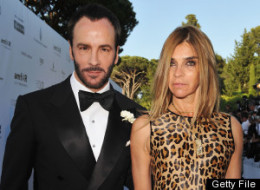
The issue is the last for French Vogue's controversial editor, Carine Roitfeld, who has stepped down. Roitfeld has been known to mocking indulge the media's worst impulses. (See also: Plastic surgery erotica, "fat" model eating.)

The spread, entitled "Cadeaux" (gifts), goes the full Pretty Baby.Roitfeld devotees immediately started speculating about what would be next for the Parisian powerhouse. Perhaps some sort of collaboration with Tom Ford?


That guess kinda made sense -- Carine handed over the glossy's holiday issue to Ford and she's constantly praising the designer, previously telling WWD, "I always say, 'Tom has an eye like a scanner.' [....] He is truly multitalented."


However, according to Ford, "Carine and I have no plans to work together at the moment, and it is nothing that we have even discussed, but of course I think she is brilliant and we are close friends so who knows about the future."


So, who is to replace Roitfeld? According to the former Creative Director of French Vogue Fabien Baron (who spoke with the Times), the mag's current Fashion Director, Emmanuelle Alt, will probably assume the position.


Monday, January 3, 2011

Bryce Dallas Howard, Face of Kate Spade


According to WWD
MONDAY JANUARY 3, 2011

KATE PICKS BRYCE: For the first time in the company’s 18-year history, Kate Spade will feature a celebrity in its advertisements, beginning this spring. The actor in question, Bryce Dallas Howard, also happens to be a brand devotee. “The Kate Spade offer came up and I kind of lost my mind. There’s something about that brand that, from a young age, I really, really, really connected with. It was always the thing I wanted for Christmas…since I was 15 or 16,” said Howard. “It represents a lifestyle that I always really loved.…It’s my first experience [in an ad campaign]. But I wouldn’t have been good otherwise.…It just would have been obvious if I weren’t into the brand.”

Deborah LLoyd, president and chief creative officer of Kate Spade, said, “We’ve been looking for someone to have a partnership with, as opposed to a flirtation. We loved her, and that she grew up with the brand.…She’s not just a pretty face. She’s a multitalented woman, which represented the brand very well.”

The quirky, neon-hued advertisements feature Howard in head-to-toe Kate Spade (“except for the nail polish,” said Lloyd) in playful poses on roller skates, riding a bike and shouting into a bullhorn. “It was so much fun, it was all the things that I like to do: bike riding, a lot of dancing, hopping around, being playful and fun, and nothing felt at all staged,” Howard insisted.

The ads prominently display the company’s latest handbag silhouette, the Scout satchel, in various bright hues and sizes. Beyond her modeling duties, Howard has a full schedule as of late, thanks to her toddler son, Theodore, in addition to the four films she’s starring in, writing and producing.

Wednesday, December 29, 2010

Cosmetic Surgery Among Teens

Last year (2009) an estimated 400,000 teens had some form of cosmetic procedure, and an estimated 210,000 elective plastic surgeries!

The most common procedure among teenagers is breast enhancement and often the surgery is given as a "gift" to the teen for Christmas, her birthday or even graduation. Many of these teens have mothers who have had a breast enhancement procedure prior and feel it is ok for their teenage daughters to have them. Many of these teens are 16 or 17, but some are younger.

Most teens who start with plastic surgery at a young age, continue on to nose jobs, eye lips, ear tucks, liposuction and many others. Parents defend these decisions by stating that they would rather have the teen discuss the issues with them and be involved in the decision-making process.

Interestingly, the American Society of Plastic Surgeons (ASPS) reports a difference in the reasons teens give for having plastic surgery and the reasons adults do: Teens view plastic surgery as a way to fit in and look acceptable to friends and peers. Adults, on the other hand, frequently see plastic surgery as a way to stand out from the crowd.

The number of teens who choose to get plastic surgery is on the rise. According to the ASPS, over 333,000 people 18 years and younger had plastic surgery in 2005, up from about 306,000 in 2000. In a recent study done by the ASAPS (American Society for Aesthetic Plastic Surgery), it was found that 18-24 year-olds of both genders were the highest rated group for approving of cosmetic surgery. The president of the ASAPS, Dr. Scott Spear, believes it’s because of the lowering costs and increasing social acceptability of talking openly about cosmetic surgery. Procedures that were once thought to be only possible for the wealthy is now becoming available for the common person.

At what age is too young? For decades, plastic surgery for teenage girls meant one thing -- a nose job, frequently performed during the summer between high school and college. While rhinoplasty remains the most common cosmetic operation for teenagers, doctors are performing an increasing number of procedures such as breast implants, liposuction and tummy tucks on young women and even girls as young as 14.

With the increase in cosmetic surgery among celebrities and the growing pressure among teenagers in an image-driven world, teens are more conscientious about their looks than ever and feel pressure to conform to the ideals set by society.

While some might understand the pressures, around the world, this is going to extremes. Australian teens are rushing to other countries for cosmetic surgery in an attempt to "reclaim" their youth, Australia's Herald Sun reports.

One 18-year-old single mother, Ambah Young, plans to head to Malaysia to have a tummy tuck, breast augmentation and a "designer" vagina procedure, according to the Herald Sun.

Approximately 400 Australians travel to Malaysia each year through Gorgeous Getaways, a group that books "cosmetic surgery holidays," and 80 percent of these individuals undergo two or more procedures, according to the report.

In the US, the most common cosmetic procedures among teens are:

  • · Rhinoplasty- 34,994 were performed on teens in 2009
  • · Ear pinning or an otoplasty- 7,909 procedures were done
  • · Breast Implants - more than 8000 surgeries
  • · Dermabrasion and Laser Resurfacing- Last year 9,563 microabrasions were done
  • · Liposuction procedures- 3,179 were performed
  • · Facial plastic surgery for eyelidswhich was performed 1,892 times

I just have to wonder what we are teaching teens in the home? What kind of values are being perpetuated from mother to daughter and what mother would encourage her daughter to have breast implants at 17 years of age?

Tuesday, December 28, 2010

Japan Fashion Now

Japan Fashion Now

From September 16, 2010, to January 8, 2011

Museum at the Fashion Institute of Technology
Seventh Avenue at 27 Street
New York City 10001-5992


www.fitnyc.edu

Emerging from an economic and industrial boom in Japan in the 1960s, Japanese artists, designers, and architects found inspiration in the fusion between American pop culture and Japan's explosive consumer technologies. Placing great emphasis on an admiration for traditional Japanese art as well as the forms and ideologies of modernism via channels of fiber technology, visual imagery, and three-dimensional sculpture, Issey Miyake, Rei Kawakubo, and Yohji Yamamoto can be credited with the creation of the Japanese aesthetic in global fashion.

While these designers each have a unique perspective on cloth construction, they share a love for artistic collaboration in the development of their collections, marketing, and image. A distinct manufactured aesthetic is exaggerated, even hyperbolic, in the contemporary Japanese fashion house. This is particularly evident in the careers of Miyake and Kawakubo—the former has recruited a variety of textile and sculptural artists such as Yasumasa Morimura, Cai Guoqiang, painter Tadanori Yokoo, and architect Tadao Ando, and the latter partnered with Takao Kawasaki, an architect who conceived the majority of the designer's early Comme des Garçons boutique.


Kawakubo's empire combines an industrially inspired socialist work ethic with a nearly fanatical desire to purvey clothing as an ever-changing product of its sociocultural environment, citing both Neo-Realism and Futurism in runway collections and advertising. Miyake forms garments that celebrate the vitality and movement of the human body, particularly referencing Sudanese, Japanese, and American modes and overlaying them with the dictates of couture tailoring to communicate a liberated global aesthetic. Yamamoto exhibits the most loyalty to Japanese cloth traditions, famed for his 1990s kimono-inspired trenchcoats and shirts. Though clearly influenced by the pure geometric forms of such indigenous garments, Yamamoto finds methods of incorporating contemporary sportswear constructions and finishing details into his designs to evoke a postmodern street chic, imbued with functions of protection and durability.


Tools of Design
An interest in the evolution of fiber technology and a devotion to tonal and textural eclecticism prompts these designers to repeatedly emphasize the importance of their raw materials. Aspirations of continual movement in both fabric and structure governed the conception of the iconic pleat-setting of Miyake's "Pleats Please" series, the enigmatic twisting, piecing, and drapery of Yamamoto's designs, and the planar manipulation of Kawakubo's shrouding, texturing, and layering techniques. While Miyake has consistently employed various heat-embossing and synthetic coating textile processes to effect more modern sculptural forms, Kawakubo nods to the romantic subtleties of historic fashion, yet champions cold synthetic fibers in her executions. Most emblematic of this tendency toward ironic juxtaposition, the "lace" sweaters of the famed Comme des Garçons fall/winter 1982–83 collection featured black wool knits distressed with gaping holes to invoke the composition of lace. While Yamamoto often experiments with innovations in technical textiles and new synthetics, he also fondly executes his designs with unconventional natural materials. A vest and skirt ensemble made entirely of hinged wood slats from his fall/winter 1991 collection demonstrates a dedication to communicating the raw visual distinctions of planar form.

The New Traditions of Japanese Fashion
Miyake, Kawakubo, and Yamamoto have all contributed to the rise of Japanese fashion by communicating its aesthetic to the global market, thereby fostering an awareness of peer and successive generations of avant-garde Japanese creators such as Junya Watanabe, Junko Koshino, and Junichi Arai. Each is celebrated for fusing age-old couture tailoring with Japanese design ethos. Though the respective collections of these designers are often inextricably linked to their derivations of or deviations from Western fashion, each has used Japan's rich visual heritage as a foundation for aesthetic, social, and sometimes political collages of cultures worldwide. Much like the costumes of the
Japanese Noh, the runway designs of Miyake, Kawakubo, and Yamamoto strive toward theatricality, visual splendor, and organic movement.


VIDEO: http://www.youtube.com/user/TheMuseumatFIT?feature=mhum

Source:
Miyake, Kawakubo, and Yamamoto: Japanese Fashion in the Twentieth Century | Thematic Essay | Heilbrunn Timeline of Art History | The Metropolitan Museum of Art


For more info: http://fitnyc.edu/8726.asp

Wednesday, December 22, 2010

THE ICONS OF FASHION- PART I- COCO CHANEL

COCO CHANEL
A FASHION ICON
A REVOLUTIONARY

“Fashion is not something that exists in dresses only. Fashion is in the sky, in the street, fashion has to do with ideas, the way we live, what is happening.”
~ Coco Chanel

When one thinks of an ICON, religious iconographic images of Jesus Christ or the Virgin Mary may come to mind, or musical icons like Elvis Presley or Michael Jackson. But, in Fashion, the icons are alive and well, living in their brands and fans.

Coco Chanel is one of the first icons of fashion, one who revolutionized the fashion world, turned women's fashion around in a period when women were corseted into their clothes. She is one of the most revolutionary designers in the fashion, freeing women of corsetry and liberating them into trousers and more comfortable fashion.

She abhorred logos and the bourgoisie (rich). Raised in an orphanage, she didn't understand the world or the way society operated in the early 1900s. She started, literally, by accident as a hat designers (for hookers, well for high-paid call girls) and became known for her hats among the socialites of Paris.

She began to create revolutionary designs by the 1920's, which included men's wear influences in women's wear, dresses above the ankles and jewelry known as "paste" or fake, most notably long ropes of pearls. She was scandalous and arrogant and was often referred to as a "pit bull," according to Andre Leon Tally.

Upon her death, Karl Lagerfeld, who was one of her designers, took the helm of Chanel and brought it into the light that it is shown today. He added the two "C" logo and the bling that is associated with Chanel. Some say that, because of Chanel's love of simplicity in fashion, she is rolling in her grave at what has been done to her name.

The original Chanel suit was made of wool jersey, with unfinished edged, not lined, featuring a box cut jacket with no buttons or closures and a straight skirt cut to below the knee. It was simple and understated and practical for women of the time. In the 40's she did add some rope trim detail, but it still remained very simple. She continued to design until her death in 1969.

She is known for her pink Chanel suit and pillbox hat that Jacqueline Kennedy wore the day of the infamous parade in which her husband, President John F. Kennedy was killed. Jackie Kennedy was a fan and made her fashion popular among the elegant women of the 60s, when other designers began to make their mark.

Chanel's designs have remained classic since the 1920s, including her "little black dress," her No. 5 parfum, her classic Chanel suit, ropes of pearls, trousers and men's tweeds for women, the drop waist, and many other styles for which she is known.

Here are a few other tid bits about this icon of fashion:

She loved pockets!

Coco Chanel was so enchanted with pockets that this would prove to be the main focus of her designs in handbags for women!

For Chanel, design started as a hobby.

Chanel started her career by designing hats which later became popular among the aristocratic Parisians within her friends' social circles. At first, they were for her friends who were the high-class call girls of the time, and she soon made a name for herself among the bourgoisie.

From Hosiery to high fashion:

Coco Chanel used to work as a clerk in a small hosiery shop. Her sister was the real seamstress and got Coco a job with her in a shop sewing hosiery, among other things. It was hosiery that revolutionized her fashion world, taking her boyfriends' wool jersey long johns and turning them into warm wool dresses. Her boyfriend of the time was a coal broker and knew that WWI would change the world and told her to make warm clothes for women. Though she designed prior to WWI, she took his advice and produced knit dresses for women, under which they couldn't wear corsets. This was considered risque at the time, but she literally revolutionized women from the corset!

Coco made the sun tan fashionable!

It was Coco Chanel who made a tan seem fashionable when she got burnt by sun's rays in 1923 on a cruise towards Cannes! It soon became associated with those who had time to "leisure" on the beach!

Coco wanted to be an actress, and even auditioned on the stage.

Coco was her "stage name." Her real name was Gabrielle. She thought she could sing and dance, however, never really made it past the vaudeville stage and clubs. These clubs did turn out to be quite lucrative, introducing her to some powerful Parisians who helped launch her career.


“Innovation! One cannot be forever innovating.
I want to create classics.”
~Coco Chanel

Hotel Ritz was her home, with her first shop on the Rue de Cambon.

For more than 30 years Coco Chanel made the mighty hotel Ritz in Paris her home! It was rumored that German officer Dincklage (with whom she was having an affair) made arrangements for her to stay in the hotel.

She opened her first salon on the Rue de Cambon. The salon was modest, with living quarters above. It soon became the showroom and the exclusive location for her fashion showings for her private clientele. She would position herself on the top of the stairs, down which the models would walk wearing her latest creations.

“There are people who have money and people who are rich.” ~ Coco Chanel

5 was her favorite number

She believed there was something special in the number 5 - enough that Chanel No. 5 was introduced on 5th May 1921!

She never got married

Coco Chanel might have dated and had affairs with plenty of men but she never married.

Not only did she make “black” the black it is today,
but she also created the wardrobe classic the little black dress.

“A fashion that does not reach the streets is not a fashion.” ~ Coco Chanel